Our vision: no child left without treatment
Treating an ultra-rare disease takes more than science. It takes coordination, sustained funding, strategic partnerships, and the involvement of society as a whole.
PEOPLE
The burden of missing treatments for rare diseases falls on children and their families. Around the world, some parents and researchers have developed therapies for their own children, yet the real challenge is making that same therapy accessible to every other child with the same disease, without a company behind it.
At Fundación Columbus, we believe that if science has an answer, no child should be left without access to it. Every program we support, every family we accompany, and every treatment we make possible share one goal: to transform lives.
+55
Children treated with gene therapy
5
Active research programs in development
3
Clinical trials in Europe: SPG50, CLN7, and CTNNB1
INNOVATION
Many ultra-rare diseases originate from a single gene that isn’t working properly. Gene therapy introduces, replaces, or silences that gene in the patient’s cells, giving it the instructions it needs to function correctly. It doesn’t treat the symptoms: it targets the cause.
A defective gene causes the disease
The vector delivers an edited gene
The cell repairs itself, improving the patient’s life
Are you a physician, researcher, or institution?
Request the technical details of our programs
Goal 10
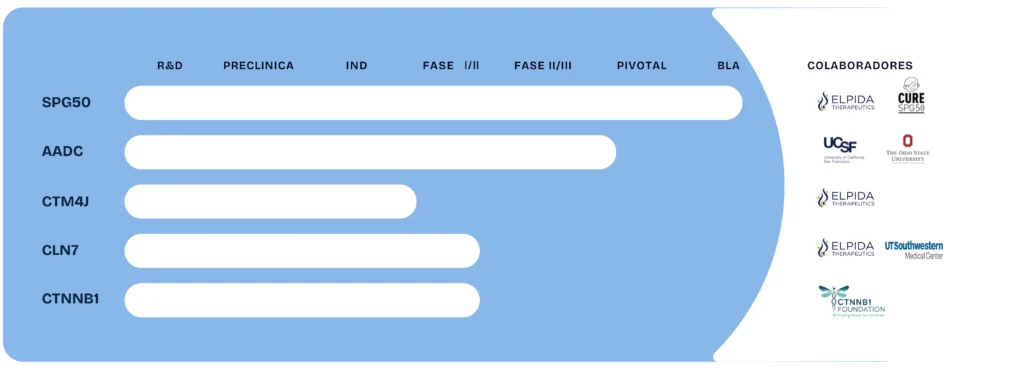
Today, we’re working on five active programs. Each one represents years of research, scientific partnerships, and families who refused to give up. Our goal is to develop 10 effective treatments for 10 ultra-rare diseases.
Gene therapy using an AAV2 vector carrying the AADC gene
Phase I/II
In the U.S.
Program lead
32
children treated
AADC is an inherited neurological disorder that prevents the brain from producing dopamine and serotonin, causing developmental delay, low muscle tone, spasms, and loss of motor control from the first year of life. Gene therapy delivers a functional copy of the defective gene directly into brain cells, with remarkable results: improved head control, fewer involuntary movements, and, in many cases, the recovery of speech and walking. This was the first disease we treated, led by Dr. Bankiewicz, a world-renowned expert in neurorestorative medicine and Professor of Neurological Surgery at UCSF.
*This program is currently available only in the United States. Contact info@fundacioncolumbus.org for more information about the project.
Gene therapy using an AAV9 vector carrying the AP4M1 gene
Phase III
In the U.S. and Spain
Elpida Therapeutics — Program lead
16
children treated (5 in Spain)
SPG50 is a slowly progressive neurodegenerative disorder marked by global developmental delay, moderate to severe intellectual disability, impaired or absent speech, microcephaly, seizures, and progressive motor symptoms. Over time, muscle tone problems leave patients dependent on a wheelchair. This spasticity can extend to the upper limbs, which may lead to quadriplegia or the partial or total loss of use of all four limbs and the torso.
There are no approved treatments to prevent, slow, or reverse the disease. Together with Elpida Therapeutics and Viralgen, we’re driving the development of Melpida, a gene therapy for SPG50. In April 2025, Hospital Sant Joan de Déu Barcelona (HSJD) and Fundación Columbus signed a collaboration agreement to build an ecosystem of expert knowledge in advanced therapies for rare diseases in Spain. Thanks to this partnership, the first child under 3 with SPG50 was treated in Spain, opening the door to new hope for children across Europe with this disease.
GOAL: €1,000,000 — DEADLINE 2028
What it covers:
Gene therapy using an AAV9 vector carrying the CTNNB1 gene
The CTNNB1 gene is the most common cause of misdiagnosed cerebral palsy. It’s a severe neurodevelopmental disorder caused by an alteration in the CTNNB1 gene. The syndrome is associated with developmental delay, intellectual disability, speech difficulties, motor difficulties, and behavioral disorders, including symptoms of autism and ADHD. There are no approved treatments to prevent, slow, or reverse the disease.
Together with the CTNNB1 Foundation, led by Špela Mirosevic, the CTNNB1 Spain Association, and Viralgen Vector Core, we want to bring Urbagen to life: the world’s first gene replacement therapy for this disease.
Since then, we’ve been working together to treat the first patients in the first clinical trial, expected in late 2025 or early 2026.
GOAL: €750,000 — DEADLINE 2027
Gene therapy using an AAV9 vector carrying the FIG4 gene
Phase I
Europe
0
children treated
CMT4J is an inherited peripheral neuropathy caused by mutations in the FIG4 gene, causing progressive muscle weakness, loss of sensation, and respiratory failure. It’s frequently misdiagnosed as ALS or CIDP. The disease progresses steadily, compromising patients’ mobility and independence. There are no approved treatments to prevent, slow, or reverse the disease.
Together with Elpida Therapeutics, CMT Research Foundation, CureCMT4J, and Viralgen, we’ve funded the manufacturing of ELP-02, the first gene therapy for this disease. The first clinical trial begins in May 2026 in the U.S.
*This program is currently available only in the United States. Contact info@fundacioncolumbus.org for more information about the project.
Gene therapy using a self-complementary AAV9 vector (scAAV9) carrying the MFSD8 gene
Phase I
In the U.S.
Elpida Therapeutics — Program lead
4
children treated
CLN7 is a lysosomal neurodegenerative disease and one of the rarest forms of Batten disease. It’s caused by mutations in the MFSD8 gene and leads to progressive vision loss, treatment-resistant seizures, and severe cognitive and motor decline. Onset typically occurs between ages 2 and 7. The disease progresses to a vegetative state and, generally, death in adolescence. There are currently no treatments to prevent, slow, or reverse the disease.
Together with Elpida Therapeutics, we’re working on the development of the first gene therapy for this disease. The first clinical trial is expected to begin in 2026 in the U.S. and Spain.
GOAL: €550,000 — DEADLINE 2031
Goal 10 goes beyond our active programs. Before adding a new disease, we assess its scientific viability: an identified gene, an estimated patient population, a viable AAV vector, and an organized patient community. Lafora disease is next on our list.
Researching a disease that fits our focus?
We drive scientific innovation around the world, wherever it’s needed most, connecting researchers, institutions, and biotech companies to accelerate the development of therapies that would otherwise take decades to arrive. We also act as an amplifier: we raise awareness, build bridges, and make visible what science is achieving.
6
Active research projects
+20
Institutional partnerships
1
Active international consortium


CULTURE
Every concert, every festival, every fundraising event we organize has one clear purpose: funding access to therapy for children with ultra-rare diseases. Culture lets us reach more people, build awareness, and turn that support into real access.
+70
Cultural, scientific, and sporting fundraising events
5
Editions of our charity festival
+15
Cities reached through our events
The 5th RenHacer Festival comes to Oviedo on May 30 and Arantzazu on June 13. Proceeds will fund the launch of the Phase 1/2 clinical trial for CTNNB1 syndrome at Hospital Sant Joan de Déu. One ticket, one step closer to Urbagen.
Since 2017, every step forward has been possible thanks to those who believed in it.